
Pools, clubhouses, and walking trails used to be the checklist for a great master-planned community. Now developers around the country are adding something new to that  list: a brewery or beer garden. A recent feature in Builder Magazine highlighted how communities like Moxie in Lockhart, Texas, and Braden in Sacramento, California, are building breweries into their town centers as “cultural living rooms” — gathering spots designed to fight loneliness and build real neighborly connection. It’s a trend worth watching here in the Las Vegas Valley, especially since several of our own established communities are missing this piece.
Why Buyers Are Asking for This
According to the America at Home Study cited in the article, 31% of homebuyers said a community hub with a microbrewery, patio seating, and live music would be an important factor in choosing where to buy — and that number climbs to 34% among Millennials. The demand lines up with two other bodies of research. The U.S. Surgeon General’s 2023 advisory on loneliness found that roughly half of American adults report experiencing loneliness, and named community design as one of the tools to rebuild connection. And the National Association of Realtors’ Community and Transportation Preference Survey found that 89% of respondents want sidewalks and places to walk, 82% want to be within walking distance of shops and parks, and nearly two-thirds would pay more to live somewhere walkable. Taken together, the message is consistent: buyers aren’t just shopping for square footage, they’re shopping for a place to belong.
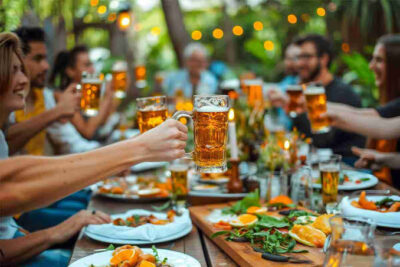 An Idea With Deep Roots
None of this is new — it’s a return to something older. In England, interwar council housing estates like Downham in South East London and Quarry Hill in Leeds were built with large, purpose-designed pubs at their center, meant to serve every age of drinker in the neighborhood the way a village pub always had. In Germany, Biergartens trace back to 1812, when Bavaria’s King Maximilian I allowed brewers to sell beer in the gardens above their cooling cellars, shaded by chestnut trees planted over the tunnels below. Those gardens became inclusive gathering spaces open to all classes, so much so that Bavaria’s 1999 Beer Garden Ordinance formally recognizes them as fulfilling an “important social and communicative function.” The brewery-anchored town center isn’t a marketing gimmick — it’s a centuries-old formula for building a neighborhood that developers are simply rediscovering.
Vegas Has Tried This Before
Las Vegas has its own chapter in this story, and it’s worth knowing before assuming this is just a marketing trend. Until the early 1990s, state law didn’t allow breweries to operate in the city at all. That changed in 1993, when Tom “Big Dog” Wiesner, owner of the Holy Cow! Casino on Las Vegas Boulevard, persuaded the state to change the law so he could add Nevada’s first brewery to his casino. It worked: Holy Cow’s beers won national awards and supplied several other Big Dog’s properties, before the casino itself closed in 2002 amid the post-9/11 tourism slump.
Other casinos followed. The Monte Carlo opened the only brewpub on the Strip when it debuted in June 1996, but stopped brewing on-site a decade later once construction of CityCenter took over the building it used, and the pub closed for good during the resort’s 2016 remodel into what’s now Park MGM. Downtown, Main Street Station added its Triple 7 Restaurant and Microbrewery that same year, becoming the first brewery in Downtown Las Vegas — and it’s still pouring today. Ellis Island’s on-site brewery, added in 1998, grew into one of the state’s most-awarded breweries before the casino demolished it in 2022 to make room for more casino floor, shifting production to an off-site facility.
The pattern is familiar: casinos have long used an in-house brewery to stand out, then absorbed, relocated, or cut it loose once the real estate became more valuable for something else. Master-planned communities are now borrowing the same idea — a signature, locally brewed gathering spot — but building it in as a permanent piece of the town center rather than a novelty competing with a casino floor for square footage.
Why This Fits the Las Vegas Market
Las Vegas and Henderson have a head start already. Local names like Tenaya Creek, Able Baker, and CraftHaus have shown there’s real appetite for neighborhood breweries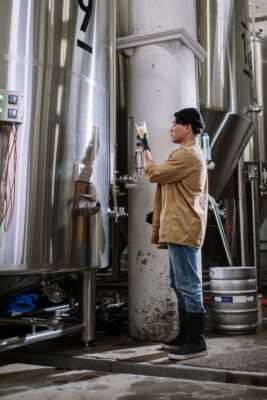 here, and our valley is home to several of the top-performing master-planned communities in the country — Cadence ranked No. 3 nationally and Summerlin landed in the top 10 in recent John Burns Real Estate Consulting rankings. Both are already built around walkable village centers, which makes a hyper-local brewery or beer garden a natural next step.
The Gap in Our Established Communities
Here’s the catch: many of our valley’s well-established communities were master planned years before this trend took hold, and their town centers and retail pads simply don’t have this kind of amenity yet. That’s not a dead end — it’s an opening. Underused retail space in an established village center can often be repositioned for exactly this kind of concept, giving an older community a fresh reason for buyers and renters to take a second look.
Does the Math Actually Work?
There’s real research behind this, not just intuition. A 2020 study in Papers in Applied Geography, “Going out for a Pint,” mapped brewery locations against Walk Score across San Diego and found that walkability correlates with brewpubs — the taproom-style breweries that sell most of their beer on-site — but not with standalone production microbreweries. Urban planners use a “5-minute walk,” a quarter-mile radius, as the standard distance people will cover before defaulting to a car; it’s the same benchmark Starbucks uses for site selection. Beyond that walk-up ring, site selectors typically layer on a 10-to-15-minute drive-time radius to capture weekend and destination traffic. The economics back it up: a half-barrel sold through the taproom nets roughly four times what it nets wholesaled to a distributor, so walkability isn’t just a nice-to-have, it’s the lever that drives the margin.
If you’re touring a community marketing a brewery or beer garden as an amenity, it’s worth asking the developer a few pointed questions: how many rooftops sit within that quarter-mile walk-up radius, and is the concept designed as a walkable taproom or just a beer-branded restaurant on a drive-to pad? Buyers and developers alike should push on this the same way they’d ask about school boundaries or park access — it’s a real, measurable amenity, not just a logo on a sign.
For investors weighing whether a specific brewery or taproom concept pencils out in a given community, that’s exactly the kind of trade-area math our Premier Homes Business Brokerage department can run — walk-up density, drive-time population, and taproom-versus-wholesale economics — before you commit to a lease or a deal. Contact them early in the process, not after you’ve already signed.
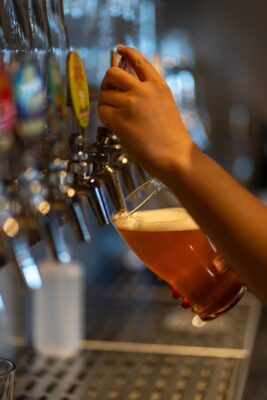 Meet Our Business Brokerage Team
This is where Premier Homes Business Brokerage comes in. This department specializes in business sales and leasing — working directly with entrepreneurs who want to buy, sell, value, or lease space for the kind of local bar, restaurant, or brewery concept that could fill exactly this gap in an established community. Whether you’re a business owner looking to relocate into a retail village center or a community exploring what kind of operator could anchor an empty pad, he can walk you through the deal.
What Buyers Should Know Before Touring New Communities
If a brewery-anchored community catches your eye, keep one thing in mind: you must bring your Premier Homes Real Estate agent with you on your very first visit to any new home builder’s sales office or model home tour. Builders will not add your agent after that first visit — representation has to be registered right at the door, or you lose the benefit of having someone in your corner during contract review, upgrade pricing, and incentive negotiations. Our new home specialist handles exactly this, so loop him in before you ever step onto the lot.
The Investment Angle
For investors, amenities like this matter too. Our Property Management department regularly fields questions from renters looking for exactly this kind of walkable, social community, and Business Brokerage tracks which growth corridors in the valley are primed for retail and hospitality concepts like a local brewery. Because all three of our departments meet regularly to compare notes, any Premier Homes agent you work with can speak to how an amenity like this affects both livability and long-term value.
The bottom line: as more Las Vegas-area developers look to build “social ROI” alongside financial ROI, don’t be surprised if your next favorite hangout — new build or retrofit — is a short walk from your front door.
Curious which Las Vegas or Henderson communities are planning amenities like this, or want to explore bringing one to your own neighborhood? Contact Premier Homes today — our Real Estate, Business Brokerage, and Property Management departments know the valley’s master-planned communities inside and out, and we’ll make sure you have the right representation and the right department from your very first conversation.