


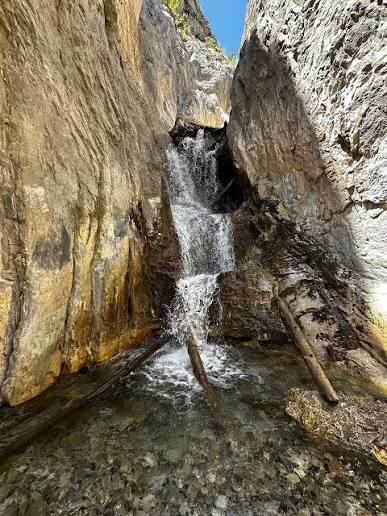
If it’s August and you’re reading this from the Las Vegas Valley, you already know why this stop in the series exists: it’s hot, and Mount Charleston is the fastest way out of it. Less than an hour from the Strip, the Spring Mountains climb to nearly 12,000 feet, and the temperature drops roughly 20 to 30 degrees the higher you go. This time, we’re sending you to a genuine waterfall, in the desert, thirty minutes from a slot machine.
A Real Waterfall in the Spring Mountains
Little Falls is a spring-fed, 30-to-50-foot waterfall tucked into a narrow limestone box canyon off the Cathedral Rock Trailhead in Kyle Canyon. Unlike a lot of Southern Nevada’s seasonal flows, this one runs reliably even in the dry months, which is exactly why it’s worth the drive. The short spur trail winds through a shaded canyon with pine and fir overhead, a genuinely different world than the desert floor forty minutes back down the mountain.
What You’ll Actually Get to Hike Right Now
A quick and important note: several of Mount Charleston’s best-known trails were damaged by Tropical Storm Hilary back in 2023, and recovery has moved trail by trail rather than all at once. Cathedral Rock Trail itself reopened in May 2025 after nearly two years of repair work. Mary Jane Falls Trail and Trail Canyon Trail are still closed, with the Forest Service targeting a fall 2027 reopening for Mary Jane Falls once a rerouted trail and rebuilt parking area are finished. None of that affects this trip, though: the Cathedral Rock Trailhead has stayed open throughout, and it’s the access point for both Little Falls and the South Loop Trail. The out-and-back to Little Falls runs about 1.5 miles round trip with roughly 300 feet of elevation gain, an easy-to-moderate hike that includes a bit of scrambling over smooth logs and rock near the falls. Trail status on this mountain shifts throughout the year, so it’s worth a quick check of the Forest Service’s current conditions and closures page the morning you head up.
How to Dress and Prepare
Pack layers even in August, the mountain runs 20 to 30 degrees cooler than the valley floor, and afternoon monsoon storms are common in summer, so aim for a morning start. Wear closed-toe shoes with a good grip for the log scrambles near the falls, which get slick when wet. Bring water and sun protection, even though you’re in the trees, elevation still means stronger UV exposure. Stage One fire restrictions are currently in effect on the mountain, so campfires are only permitted in developed fire pits and grills. Cell coverage is inconsistent past the trailhead, so download a map ahead of time.
Where to Eat and Extend the Day

Skip the old Mt. Charleston Lodge for now; it burned in a 2021 fire, and its rebuild is still under construction with no reopening date yet. Instead, make a loop of it: drive the scenic 20 minutes over Deer Creek Highway to Lee Canyon and grab a burger at Bighorn Grill, open Friday through Sunday, 10 a.m. to 5 p.m., with a patio looking out over the ski resort. It’s a fitting way to close out a series that started with a literal bighorn sheep herd and a canyon full of their petroglyphs, now capped off with a restaurant named after them.
The Shot Worth the Hike
Little Falls itself is the shot: frame it from the canyon floor looking up through the narrow limestone walls, with the water catching whatever light filters down through the pines. It photographs well even at midday, since the canyon stays mostly shaded, which is rare for anything in this series so far.
Why Kyle Canyon Is Its Own Kind of Market
Kyle Canyon’s housing stock doesn’t look like anything else in the Las Vegas valley: A-frame and log cabins, custom mountain homes, and full-time residences scattered through a community surrounded almost entirely by the Humboldt-Toiyabe National Forest. Prices range from A-frames starting around $400,000 up past $1.5 million for larger custom builds, and because there’s essentially no room left to build, that limited inventory tends to hold its value well. A lot of buyers here aren’t looking for a primary residence at all; they’re buying a second home or a vacation rental specifically to escape valley heat the way we did today, and cabins here stay in demand with renters for exactly that reason.
If a mountain cabin sounds like the right kind of real estate diversification, Premier Homes Real Estate can walk you through what buying in a national forest gateway community involves. And if you’re thinking about the rental income side of a Kyle Canyon property rather than living there yourself, Premier Homes Property Management can help you figure out what that actually looks like.
That’s four stops into this series, from a city park herd to a canyon full of their ancestors’ artwork to the mountain that gets you away from all of it. We’ll keep finding reasons to leave the valley.
Thinking about a move to Mount Charleston, the Las Vegas valley, or anywhere in between? Contact Premier Homes today — our Real Estate, Business Brokerage, and Property Management teams work together so you get the whole team’s knowledge, not just one agent’s.