
Picture this: you leave your house in Summerlin, grab a coffee, and a couple hours later you’re stepping off a train in the middle of Southern California — no security line, no Cajon Pass gridlock, no white-knuckle drive through the desert on a Friday afternoon with 200,000 other people trying to do the same thing. That’s the promise of Brightline West, and it’s no longer a rendering on a website — it’s steel, concrete, and cranes rising along I-15 right now.
This isn’t just an infrastructure story. It’s a story about what Las Vegas is about to become.
The Fastest Way From Here to There Is About to Get a Lot Faster
Right now, the drive from Las Vegas to Los Angeles is a rite of passage — and not the good kind. Four-plus hours if you’re lucky, double that if you’re stuck behind an accident at the Cajon Pass on a holiday weekend. Brightline West collapses that entire ordeal into a fraction of the time, at speeds up to 186–200 miles per hour, running in a 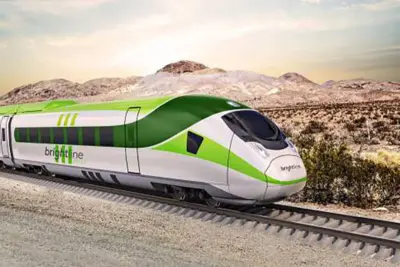 dedicated corridor down the median of I-15. Depending on the source and the exact stop pattern, quoted trip times range from as fast as 55 minutes for the shortest express segments up to a bit over two hours end to end — the point is, whatever the final number lands on, it’s a different category of trip than the drive.
The numbers behind it are staggering: a 218-mile line, a price tag that’s climbed toward $21 billion, a $3 billion federal grant already banked, billions more in bonds issued, and dirt already moving at the future Las Vegas station site near the 215. The Las Vegas station’s parking garage is visibly taking shape. This is the most real a Vegas-to-LA train has ever been.
Is it running tomorrow? No — the latest target is late 2029, a delay from the original goal of beating the 2028 LA Olympics. But make no mistake: this thing is being built, and when it opens, it changes the map.
For Comparison: How Fast Is “Fast,” Really?
If you want a gut check on what a two-hour-ish train ride actually buys you, look east. Amtrak’s Acela — America’s only other true high-speed service — runs New York to Washington, D.C. in about 2 hours 45 minutes, and New York to Boston in around 3 hours 30 minutes, even with the brand-new NextGen trainsets that just launched. Those routes are shorter than Vegas-to-SoCal in miles but slower in practice, because Acela shares aging track with freight and commuter rail and tops out around 160 mph. Brightline West, by contrast, gets a dedicated, purpose-built corridor down the I-15 median — no freight trains, no shared track, no legacy infrastructure slowing it down. If it delivers anywhere near its target speeds, it could end up being the fastest scheduled train in the country, coast to coast.
What This Means If You Own a Home in Clark County
If you own property in Las Vegas or anywhere in Clark County, pay attention — because history says rail lines like this move real estate.
Right now, Clark County’s median home price sits around $420,000–$460,000, already up nearly 40% since 2020. Brightline West is being cited by local market watchers as one of the next big structural growth drivers for the region — right alongside population growth and mega-development. Here’s why that matters: a fast, reliable train ride doesn’t just move tourists. It moves buyers.
Suddenly, someone priced out of Los Angeles, Orange County, or the Inland Empire doesn’t have to give up on Southern California living — they can own in Las Vegas and treat LA as a quick train ride away, not a life-altering relocation. That’s a massive expansion of the buyer pool for Clark County, especially for property near the future station corridor in the southwest valley. Second homes, investment properties, and remote-flexible buyers from California could all pour into a market that’s currently taking a breather. Homeowners near the line aren’t just buying a house anymore — they’re sitting on a future transit-oriented asset.
Does This Make Vegas a Suburb of LA? Not Quite — But Close Enough to Matter
Let’s be clear: Las Vegas isn’t becoming Pasadena. It has its own economy, its own identity, its own gravity — gaming, conventions, entertainment, and now, increasingly, film and tech. A fast train doesn’t erase that.
But it does something arguably more interesting: it stitches Las Vegas into the Southern California megaregion as a lower-cost, high-amenity satellite — something closer to what Philadelphia is to New York. Independent, but functionally connected. Close enough to commute for a meeting. Close enough to live in and work in LA a few days a week. Close enough that the two cities start to behave, economically, like one sprawling metro rather than two separate markets separated by a brutal drive.
That’s not becoming a suburb. That’s becoming something new — and it could be the single biggest identity shift for Las Vegas since the Strip went corporate.
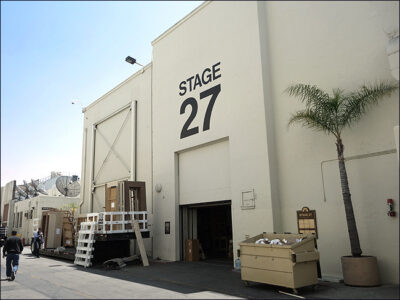 Lights, Camera, Las Vegas: The Hollywood Connection
Here’s where it gets genuinely exciting. While Brightline West lays track, Hollywood is laying foundations of its own — in Summerlin.
Sony Pictures and Warner Bros. Discovery have teamed up with Howard Hughes Holdings on Summerlin Studios: a planned 31-acre, roughly 500,000-square-foot production hub, pending Nevada legislation and tax incentives. People are already calling it “Hollywood 2.0.”
Now connect the dots. A full-scale studio complex in Las Vegas is only as good as its ability to move people and gear between Vegas and the beating heart of the entertainment industry in LA. A train ride short enough to fit inside a workday is exactly the threshold where a trip stops being “a flight with security and baggage claim” and starts being “a same-day commute.” Directors, execs, actors, crews — able to hop a train from Burbank or downtown LA to a Vegas soundstage and back in a single day. That’s not a minor convenience. That’s the infrastructure that turns “Vegas has a studio” into “Vegas is a real extension of Hollywood.”
If this all lines up — the studio, the incentives, the train — Las Vegas doesn’t just get a film industry. It gets a seat at the table with the entertainment capital of the world, sitting a quick ride down the tracks.
Tourism Is About to Get a Rocket Boost
Convenience is the single biggest lever in travel decisions, and Brightline West is about to pull it hard.
Think about who currently doesn’t make the trip to Vegas because of the drive: the Orange County family that doesn’t want to spend a Saturday behind the wheel. The LA professional who’d love a spontaneous weekend but can’t stomach four-plus hours each way. The convention-goer flying into LAX who’d rather not deal with a connecting flight or an interminable shuttle. A fast, dependable train solves all of it — turning “someday” trips into casual weekend plans and opening the floodgates for day-trippers and short-stay visitors from one of the largest, wealthiest metro regions on Earth.
And it flows both ways. Vegas residents get frictionless access to LA’s coastline, airports, and cultural scene. Suddenly, the two cities aren’t rivals separated by a desert — they’re partners separated by a quick nap.
The Olympic Opportunity — And the One That Got Away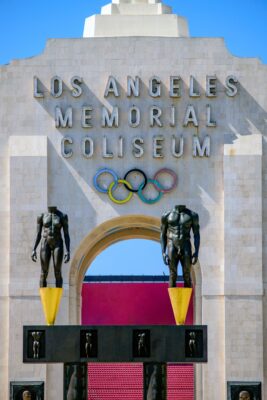
Here’s the gut punch: Brightline West was originally supposed to be running by the 2028 LA Olympics. It won’t be. The current target is late 2029 — more than a year after the closing ceremony.
That stings, because the Olympics would have been the perfect showcase moment: Vegas positioned as the overflow city for a world that can’t get an LA hotel room, ticket, or has already seen everything the Olympic host city has to offer. Global broadcasts. Millions of international visitors within striking distance. A once-in-a-generation spotlight on a brand-new high-speed line connecting two of America’s most iconic cities.
Without the train, Vegas will still play overflow city via flights and freeways — but it loses the “one seamless trip” pitch that would have made capturing that traffic effortless. The silver lining? The years immediately following the Olympics become Brightline West’s real coming-out party, arriving right as the world’s eyes are still lingering on Southern California and a newly built rail line is ready to carry them straight to the Strip.
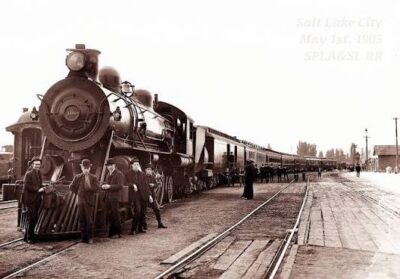 History Repeating: Vegas Was Built by a Railroad Once Before
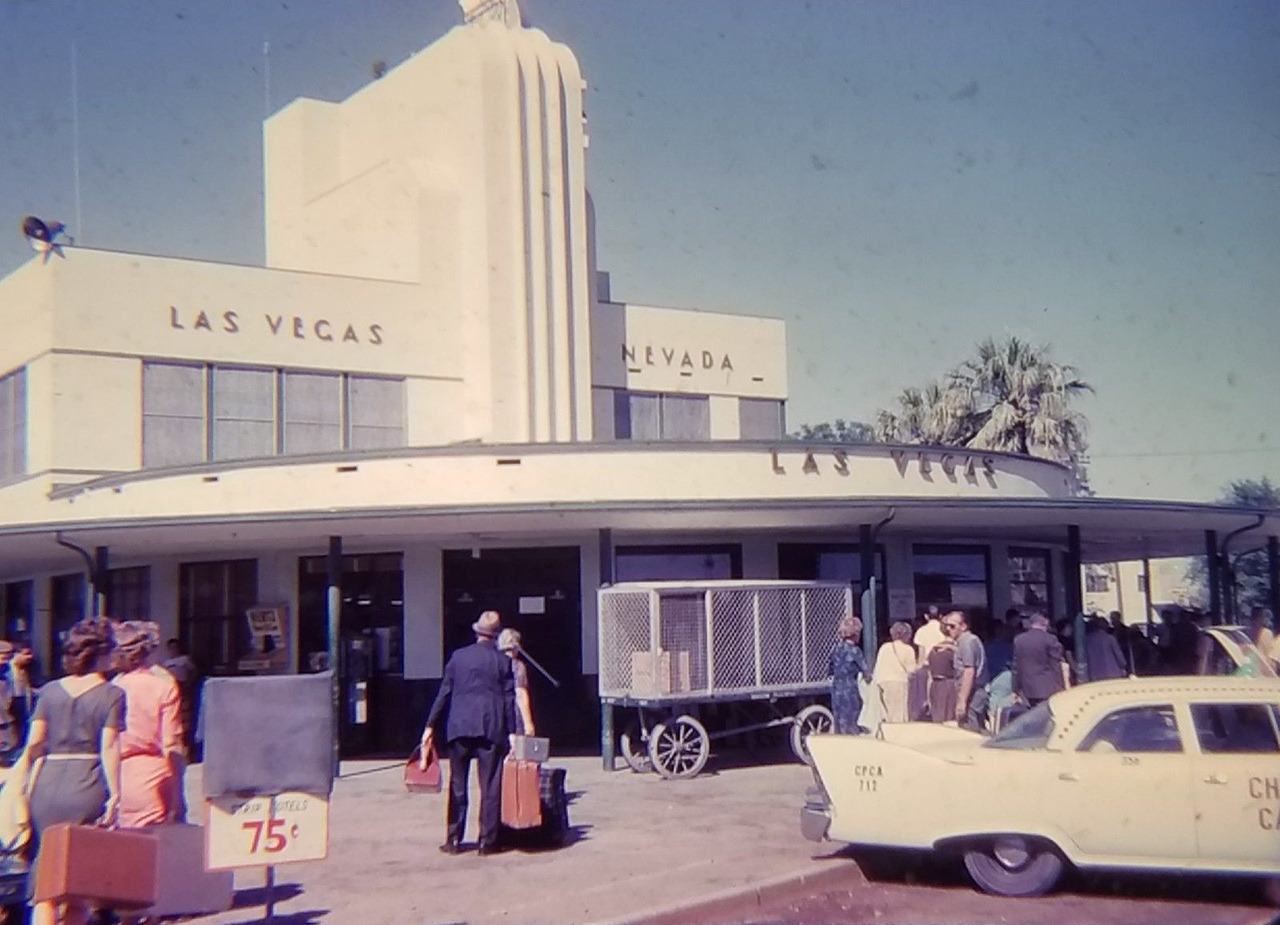
Here’s the part that makes this whole story feel less like a plot twist and more like a sequel: Las Vegas didn’t start as a casino town. It started as a railroad town — and the railroad in question was, once again, the line to Los Angeles.
In the early 1900s, copper magnate and senator William A. Clark — yes, the same Clark that Clark County is named after — built the San Pedro, Los Angeles & Salt Lake Railroad to link the port of Los Angeles to Salt Lake City. Trains started running through the Las Vegas valley in early 1905, and the town existed in the first place because the valley’s natural springs made it the perfect water stop and division point along that route. On May 15, 1905, Clark’s company auctioned off the townsite lots — that single event is recognized as the founding of the City of Las Vegas. Fremont Street, still the heart of downtown today, was laid out as the road that ran straight to the depot, and it became Vegas’s original main street: first hotels, first saloons, first gambling halls, all clustered around people getting off the train.
In other words, Las Vegas is, quite literally, a city the railroad built. It existed for decades as little more than a rail stop and water station before it ever laid down a casino carpet. So there’s something almost poetic about Brightline West: more than 120 years after a Los Angeles-bound railroad put Las Vegas on the map, a new one is arriving to redraw it again.
The Bottom Line
Brightline West is more than a train. It’s a bet that Las Vegas and Los Angeles are about to function as one connected region instead of two cities separated by a grueling drive — and everything from home values in Clark County, to Hollywood’s next big production hub, to the future of West Coast tourism is riding on it.
The track isn’t laid yet. The finish line has moved more than once. But the direction is unmistakable: Las Vegas is positioning itself to be closer to LA than it has ever been — and homeowners, investors, and anyone watching this market would be wise to pay attention now, before the rest of the world catches on.
Sources: FOX5 Vegas, Newsweek, Wikipedia (Brightline West, History of Las Vegas), Coyote Country LV, The Nevada Independent, KTNV, Zillow, Homes for Sale Vegas, Las Vegas Review-Journal, Deadline, Amtrak, Online Nevada Encyclopedia.