



A quick note before we start: we’re not security professionals or technologists. We’re homeowners who’ve spent time researching options, comparing products, and thinking through what actually makes a house harder to target. Everyone’s situation is different — the size of your porch, whether you have a garage, your neighborhood, and your budget. Take what’s useful here and leave the rest. The best system is the one that fits your house and your habits, not the one with the most features.
 Start with the obvious targets: mail and packages
Porch theft is the most common opportunistic crime a lot of us will actually face, and it’s also the easiest to solve. A locking mailbox or parcel box removes the “grab and go” opportunity entirely. Boxes like the Adoorn Package Box (around $350) let carriers drop a package through a top door into a locked lower compartment — you retrieve it with a key, nothing sits exposed. It’s a zero-installation option: no wall cutting, no permits, just place it and go.
If you want packages to land inside your house or garage rather than on the porch, a through-wall parcel drop slot is worth a look. Products like this (roughly $800) install directly into an exterior wall — the carrier drops the package into a slot from outside, and it falls through to a basket or the floor on the inside. It’s a more permanent project (cutting into studs, matching your wall thickness), but it takes package theft off the table completely because nothing is ever visible or reachable from outside.
There’s also a smart-garage option worth knowing about: Amazon’s Key In-Garage Delivery works with Chamberlain’s myQ system. You link your myQ app to Amazon, and the driver gets a one-time access code to open the garage, drop the package, and the door locks itself again automatically. No permanent access, no wall modification — just requires a compatible garage opener or a myQ hub retrofit.
None of these are “the right answer.” There are three different tradeoffs between cost, permanence, and convenience. Pick based on what your house allows and what you’re actually willing to install.
On cameras: wired is worth the extra effort
There are a lot of camera options out there, but if you’re serious about reliability, wired cameras deserve to be the default choice, not an afterthought.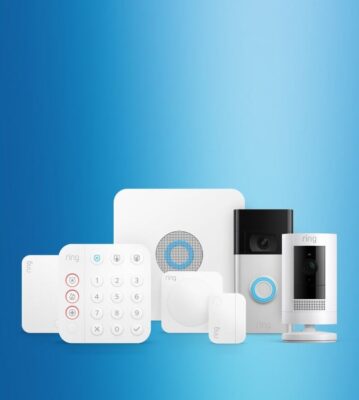
Wired systems run continuously and aren’t dependent on Wi-Fi signal strength, battery levels, or your router staying online. A wireless camera can drop footage exactly when you need it most — during a Wi-Fi hiccup, a dead battery, or signal interference — and you often don’t find out until after the fact. Wired cameras don’t have that failure point.
Wired systems are also meaningfully harder to hack. Wireless cameras transmit over the air, which means an attacker with the right tools can attempt to intercept or interfere with the signal remotely. A wired camera requires physical access to the cable to do the same thing — a much higher bar for anyone trying to compromise your system. Wireless cameras can be secured well with strong passwords and WPA3 encryption, and for a lot of households, that’s plenty. But if you’re comparing options side by side, wired is the more hack-resistant design by default, not just in theory.
The tradeoff is installation. Running cable is more work than mounting a battery-powered camera and connecting to Wi-Fi in five minutes. That’s a real cost. But for the cameras that matter most — front door, driveway, any angle covering a real entry point — we’d lean wired if your setup allows for it.
Whatever you choose, the placement principle from before still holds: visible-but-discreet beats both an obvious fortress and a fully hidden camera. Deterrence only works if a potential intruder notices the camera before they act.
Amazon Sidewalk and the newer tech worth knowing about
Amazon Sidewalk is a low-bandwidth mesh network that lets Ring, Echo, and other Sidewalk-enabled devices share a small slice of your internet bandwidth with neighbors’ devices, extending range for things like pet trackers and outdoor sensors. Amazon says it’s protected by layered encryption and that device owners can’t see each other’s data — but it’s worth knowing it’s enabled by default on eligible devices, and privacy advocates have raised real concerns about opt-out defaults on a network like this. If you use Ring products, it’s worth a few minutes in the app to check your Sidewalk setting and decide for yourself.
Beyond that, a few trends are worth watching in 2026: AI-powered cameras that can tell the difference between a person, a pet, and a car (fewer false alarms), color night vision replacing older infrared, subscription-free camera models as an alternative to the recurring-fee model most brands use now, and Matter/Thread protocols making it easier for cameras, locks, and lighting from different brands to actually talk to each other instead of locking you into one ecosystem. None of this is essential — it’s just useful to know what’s out there before you buy.
The layer that actually matters most: know your neighbors
Here’s the thing that all of this technology can’t replace. A camera records an incident. A locked box prevents one specific type of theft. But a neighbor who knows your car, your routine, and your porch well enough to notice when something’s off — and who will actually text you or call the police — is a layer that operates before anything happens, not after.
We’re not saying skip the cameras, skip the locks, skip the mailbox. Those all matter. But being neighborly isn’t a soft, optional extra sitting below the tech stack — if anything, it outperforms most of it. A house on a street where everyone looks out for each other is a harder target than a house wrapped in cameras where nobody talks to anyone. Trade phone numbers. Watch each other’s places when someone’s traveling. Share camera coverage angles so there are fewer blind spots between houses. None of that costs $350 or $800, and none of it needs a subscription.
Security is a stack: mail and package protection, solid physical hardware, cameras that actually work when you need them, and a neighborhood that pays attention. Build the stack that fits your house — and don’t skip the layer that doesn’t come in a box.
Again — we’re sharing what we’ve found useful, not prescribing a one-size-fits-all setup. Look at your own house, your own street, and your own budget, and build the system that actually works for you.
This is the same advice we pass along to every client we work with in Las Vegas and Henderson — whether you’re buying your first home, protecting a property you already own, or renting out a home you’d like managed with care. Premier Homes Real Estate and Premier Homes Property Management are always here to help, so reach out any time you want to talk through what security and peace of mind should look like for your specific property.